
Restoring Squak Mountain, One Holly Grove at a Time
By Nicole Deflaux, IATC Restoration Lead and Volunteer
Common holly (Ilex aquifolium) is a Class C noxious weed in Washington State. It shades out native understory vegetation and releases an allelopathic chemical that can be harmful to nearby native plants. It is also highly flammable, potentially increasing wildfire risk. And it's a tough bugger to eradicate from an area. Cutting the tree down won't kill it; the stump will only sprout more growth like a many-headed hydra. Instead, since March 2024, volunteers have spent 660 hours tackling 118 groves of holly on Squak Mountain using an effective method involving injecting the large trees with a particular herbicide and pulling smaller saplings and suckers from the soil by their roots, as shown in the photos below. At times it might seem like a sisyphean task, but it's worth doing. Left untreated, holly has been observed to double every 5-6 years in a closed canopy forest. This project, led by Anne Newcomb of Issaquah Alps Trails Club and Ellen Moline from Washington State Parks, is making a real impact on the health of the forest of Squak Mountain!
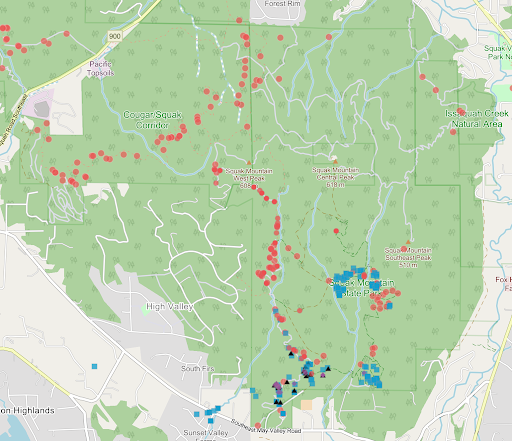
The red dots on the map indicate places where we or other users of iNaturalist have spotted holly on Squak Mountain. The blue squares are the holly groves where we have worked so far. The purple diamonds and black triangles are groves we revisited a year later; purple indicates a bit of regrowth, and black indicates groves confirmed dead. To date we have injected approximately 260 holly trees, pulled 320 saplings with a weed wrench, and pulled 4,000 plants by hand. See the live map for more detail. Courtesy of Nicole Deflaux.
But how did holly get so entrenched on Squak? In the 1940s and 1950s there were over 200 holly farms in Washington State. In fact there used to be an English Holly and Christmas tree farm on the May Valley Road, which likely contributed to the holly invasion on Squak because, in Washington, seeds from female bushes are dispersed by several species of frugivorous birds, who eat the fruit and then regurgitate the seeds in new locations. Fruits will only produce seeds if a male tree is close enough to pollinate the female flowers (with the help of bees, of course).
What can you do to help?
Join us for a restoration work party on Squak Mountain, every third Thursday of the month.
Remove holly on your own property, if applicable.
Encourage more removal of invasives from our public lands by supporting the Issaquah Alps Trails Club and other organizations in the area that do this work, including the Green Seattle Partnership and the Mountains to Sound Greenway.
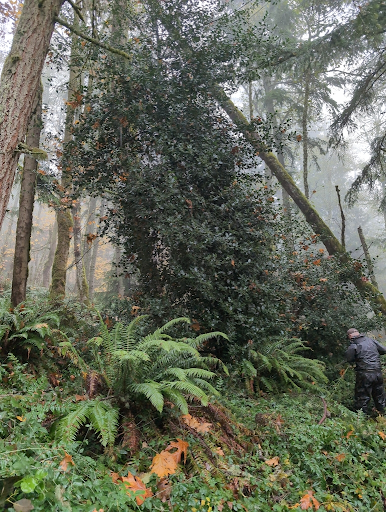
A) The holly groves can look like an intimidating tangle at first. To tackle it, start by using loppers to remove holly branches from the mother tree from head-height downward to the root base, also trimming the ends of any higher branches that are long enough to reach the soil. Courtesy of Nicole Deflaux.
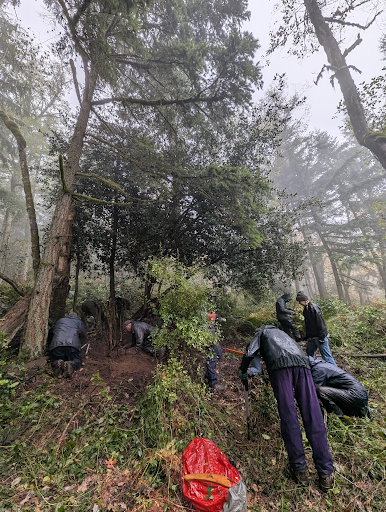
B) With the trunk cleared, we can now see what saplings and spouts remain that are coming directly up from the soil. Next, use gloved hands to uncover the roots (it is important to see how they are connected and the direction they are going). Kneel or sit while digging and gently tugging on roots. Try following the roots and gently pull one at a time so they don’t break. If a root breaks, try to find it; it will be the yellow-looking root. Use pliers to gently pull the remainder of the root from the ground. Or use a weed wrench to pull the hard-to-get ones. Gather all holly debris into a pile, ensuring none of the yellow roots touch the ground. Courtesy of Nicole Deflaux.
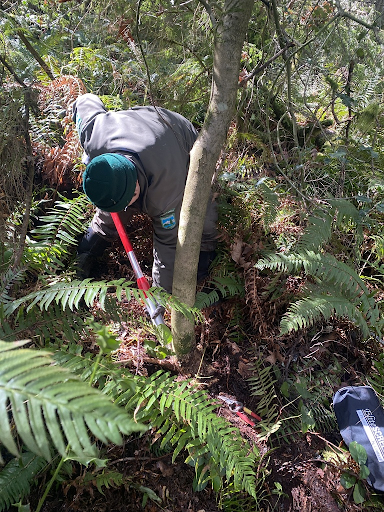
C) Ellen Moline, Washington State Parks Ranger, injecting Copperhead Imazapyr Herbicide Shells with an EZ-Ject lance into the root ball of a holly tree. Ellen has the training, license, and of course the authority to use this herbicide on Washington State Parks land. Private landowners can also do this on their own property. The shells pierce through the outer bark and into the living phloem and cambium layer to deliver the herbicide. This method is effective, and the herbicide stays within the treated holly tree, which keeps the rest of our native plants safe! Courtesy of Nicole Deflaux.
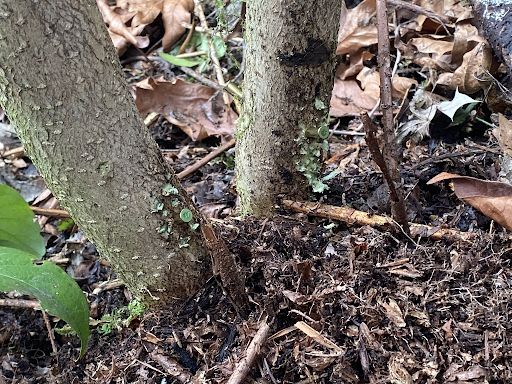
D) You can tell whether a holly tree has been treated if you see the bullet-like herbicide capsules embedded in the trunk close to the soil. We do not cut down the mother holly tree since cutting encourages vigorous sprouting. We also leave it in place so we can find the treated grove at a later date to check for any saplings we missed. It can take approximately 6 months for the leaves on a treated tree to all turn brown. Courtesy of Nicole Deflaux.
Help restore Squak Mountain! Learn more about our restoration efforts and how to get involved at our
Squak Mountain Habitat Restoration page.