
Supporter Spotlight: Tayler Nichols
This month we’re excited to feature Tayler Nichols, City of Issaquah’s Green Issaquah Volunteer Coordinator, whose passion for urban forestry, community education, and hands-on stewardship helps connect volunteers with the forests, parks, and natural spaces of Issaquah.
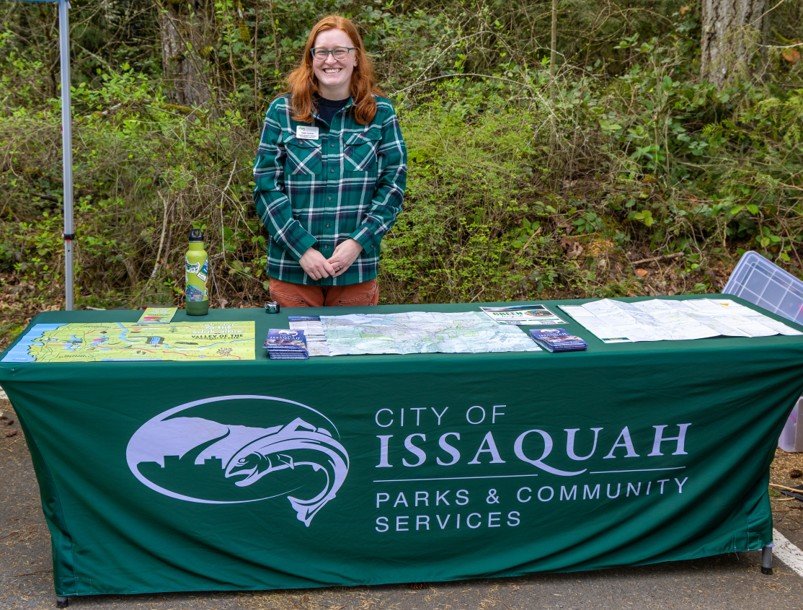
Tabling at High Point Trailhead. Photo courtesy of Tayler Nichols.
By Tayler Nichols, Green Issaquah Volunteer Coordinator, City of Issaquah
Can you tell us a little about yourself, your role as Volunteer Coordinator for Urban Forestry with the City of Issaquah, and what your work involves?
My name is Tayler (she/her). I am the Green Issaquah Volunteer Coordinator. Green Issaquah is a collaborative effort between the City of Issaquah, community groups, nonprofits, schools, businesses, and hundreds of volunteers to restore and maintain Issaquah’s 1,500+ acres of forested parks and open spaces. Through volunteer opportunities, education and outreach, and the Forest Steward program, Green Issaquah builds community-based stewardship with the goals to improve quality of life, connections to nature, and enhance the social and ecological benefits healthy forests provide.
The work that I do is very seasonal. As we are in fall, I am preparing for planting season! As you can imagine, this usually encompasses all things plants! Ordering, receiving, staging, and of course, planting them. Fall is also the start of the school year, and we often host Gibson Ek High School interns. During this time, we are getting to know our interns—their interests, questions, and curiosities—and work with them to come up with projects that excite them. In the winter there is less restoration work happening outside. Typically, this is a time to take a small programmatic pause. We usually use this time to wash gloves, get reorganized, attend trainings, and find new educational opportunities to table or present at for the spring.
Spring is where we plan for Earth Month, which may be our busiest time of the year. We are out in the community tabling and teaching, as well as exploring ways to reinvigorate community engagement in stewardship following the cold, rainy season. After Arbor Day in April, planting season has wrapped up, and we move our way to mulching and maintenance (weeding!). Summer and sunshine bring us to the height of invasive species removal and watering events. A mix of trying to clear more space for future planting and watering the recently installed plants to help them make it through the dry months.
So much of my role is about collaboration: working with community partners on events, coordinating with Park Operations and Maintenance staff to help with mulch deliveries and water trucks, and partnering with the Communications team to promote events. There are so many people that make Green Issaquah what it is, and I get to support it all. I’m behind the scenes organizing the events, making sure you have your waiver signed, and writing the newsletter; then I am out front, with the tools, helping make sure everyone has what they need—and that no one accidentally hits each other with a shovel.
In my personal time, I like to be outside as much as I can: walking, biking, and staring longingly at the creek for salmon and aquatic macro friends. But usually, it’s me with a cup of tea in hand and my feral five-year-old somewhere nearby playing outside and experiencing nature around us. Parenting has given me a fun outlook on how much I don’t know, often guided by a dozen or so “how comes?” or “but why?" It’s a good reminder not to know, and there’s still so much to learn. I have also been learning to garden and crochet, two VERY different skills from restoration work that are teaching me a great deal about patience.
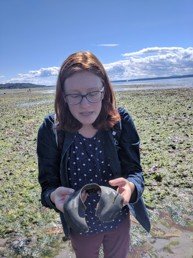
Very passionately explaining a moon snail collar. Photo courtesy of Tayler Nichols.
What first sparked your interest in conservation, urban forestry, or protecting public lands in the Issaquah area?
My academic background is in marine biology, so my adventure into urban forestry took a little bit of time. Upon moving to Washington, I spent several years as an outdoor environmental education teacher in Bellevue. It was there, learning from my peers, that I learned about the local native plants and animals of the Puget Sound. We created a rich environment where we learned from and taught one another, while also sharing knowledge with youth on field trips, some of whom were experiencing nature for the first time.
Like many people, my appreciation for urban trees started in the pandemic when I spent more time intentionally walking around my neighborhood and getting to its trees and parks. My love for urban forestry stems from how interconnected caring for the environment is. You cannot talk about tidepools and their creatures (my favorite) or about salmon without considering the upstream, surrounding habitats, and humans. Everything is connected, and I love it. I want to protect all of it. As a fun fact, I first visited Issaquah about a decade ago for a wedding and was so awestruck by the trees and the beauty of the area that I decided to move to Washington. No regrets.
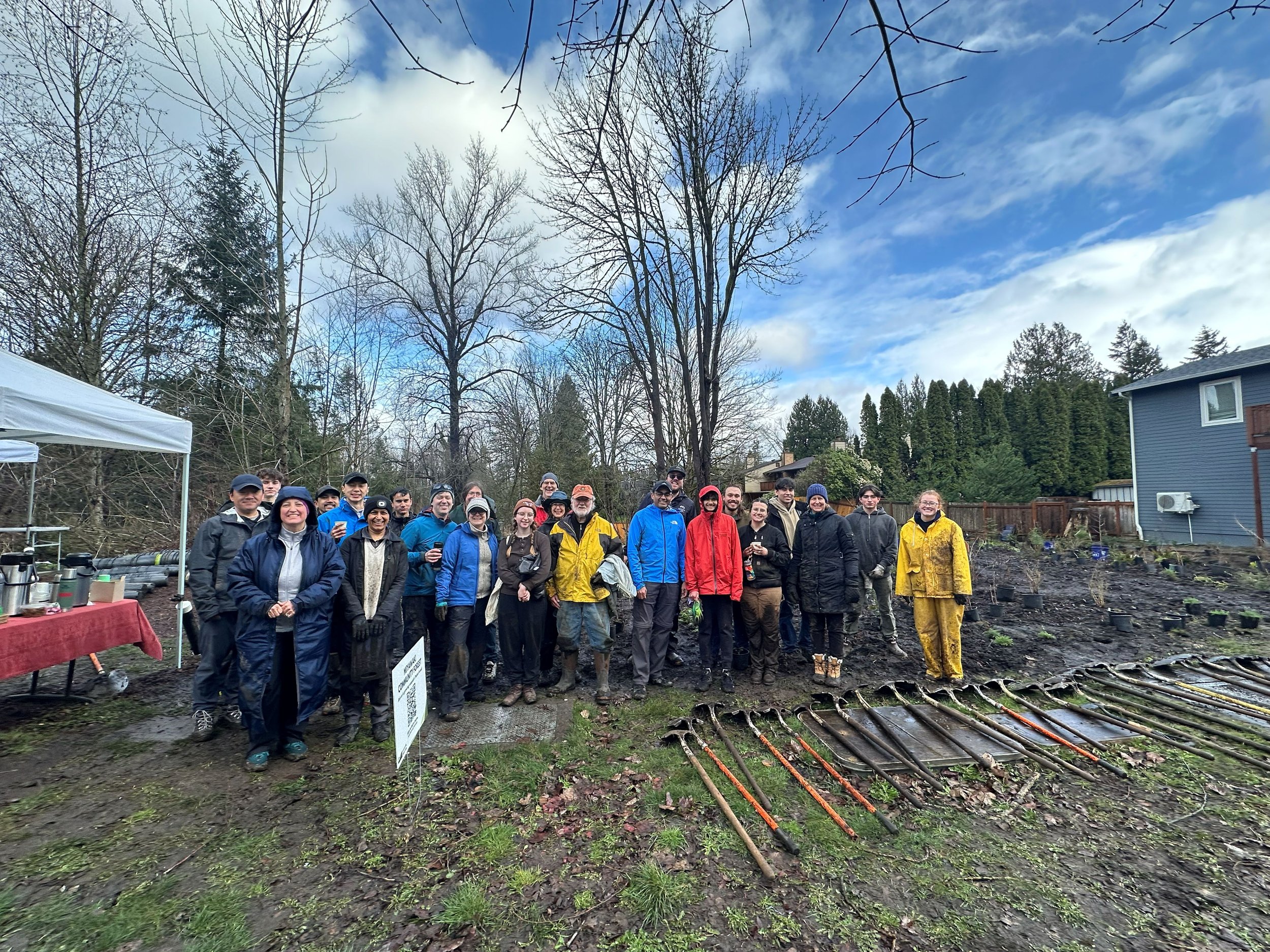
Tayler with community stewards at the Issaquah Miyawaki Forest. Photo courtesy of Kira Telgen.
Is there a trail, park, or natural area in the Issaquah Alps that is especially meaningful to you—or a favorite spot you hope to explore soon?
I am a huge fan of Timberlake Park, Confluence Park, and the Miyawaki Forest.
How have your professional or personal experiences shaped your passion for habitat restoration, working with volunteers, and community education?
I love community education, and I love learning!! As a former informal environmental science teacher, there was nothing more magical than witnessing someone’s “ah ha” moment, as they connected with a new animal or plant, bridging a knowledge gap, or finally grasping a challenging topic. I carry that joy with me always.
I love learning from passionate people and bringing that spirit of curiosity into my work with the community. It’s such a gift to help facilitate some of that through Green Issaquah. How cool is it to create opportunities for people to steward their local parks alongside their neighbors, friends, and community!
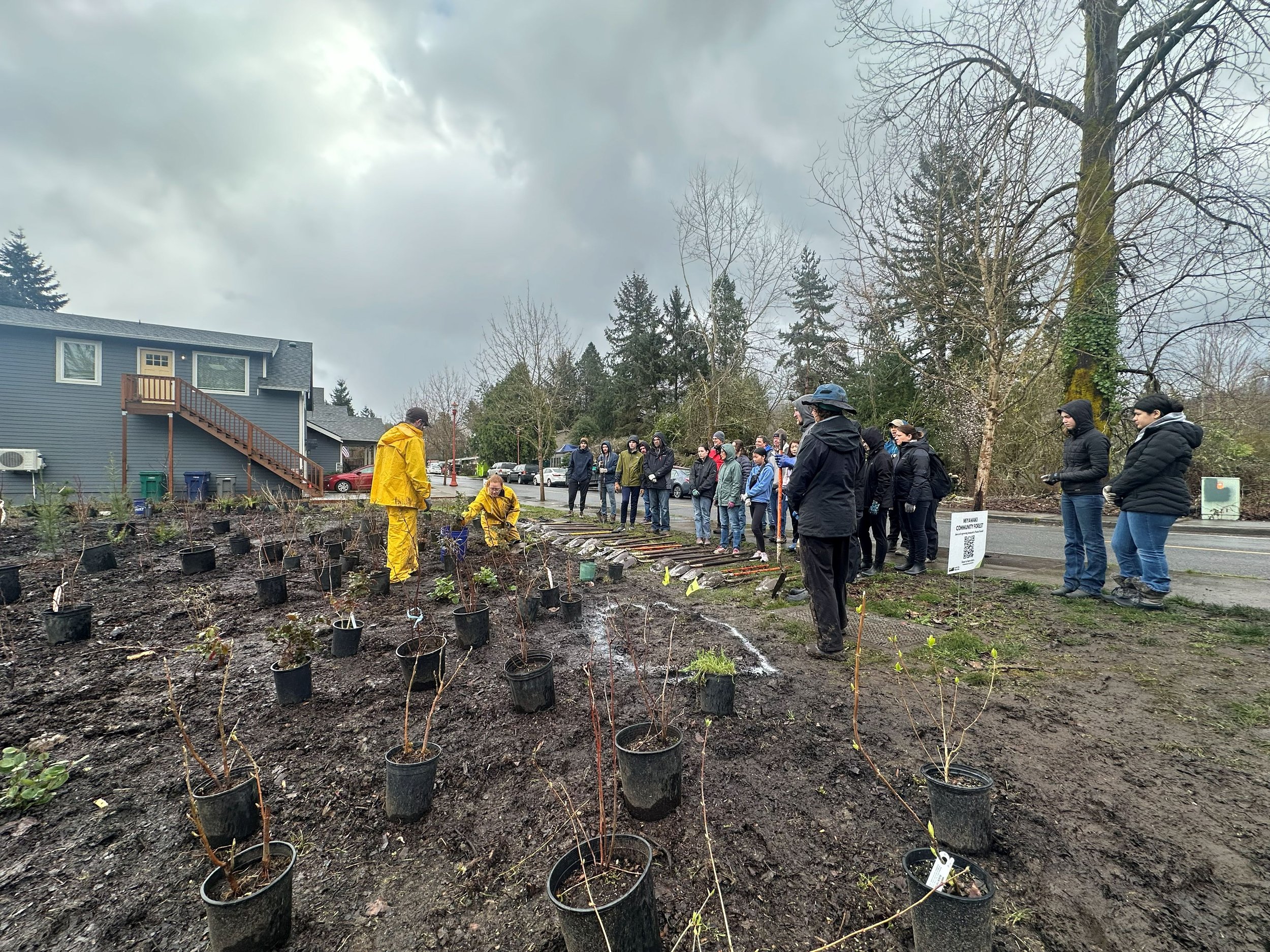
Tayler demonstrating how to plant young trees at the Miyawaki Forest Kickoff Event, March 2025. Photo courtesy of Kira Telgen.
What advice or encouragement would you give to readers who want to get more involved in conservation, habitat restoration, or protecting public lands in the Issaquah community?
There is room for everyone to get involved! And it doesn’t have to all look the same! Here are some suggested ways you can get involved in your community:
Volunteer! We are hosting our first planting event of the year, Green Issaquah Day, on October 17 at Confluence Park.
Find an organization that speaks to you. There’s no shortage of places to volunteer, from Master Gardeners and the Issaquah Food Bank to the Issaquah History Museums and other local organizations.
Create a wildlife-friendly garden. Learn more and consider certifying your space through the National Wildlife Federation’s Wildlife Habitat program.
Join (or start) a book club. Bonus points for a nature-themed read.
Join a walking or a hiking group. IATC hosts regular events.
Attend a tree talk. Issaquah’s Urban Forest Supervisor leads fascinating talks about our local trees!
Show up for local government Attend a city council meeting and learn more about what’s happening in your community.
Join the board or commission for an organization or cause you care about.
Go see the salmon! If you haven’t seen salmon in the creek, you better! Check out local viewing locations. Viewing locations!
Get to know your local trees! The City has a Heritage Tree program.
Get to know your community!
Interested in becoming a forest steward or volunteering with Green Issaquah?
Learn more about upcoming restoration events and classes.