
A Boulder, a Hike, and the Goldilocks Zone
By Larry Franks, Board Member, Friends of the Issaquah Salmon Hatchery
On a recent hike on the west flank of Tiger Mountain (rescuing sword ferns from right-of-way maintenance), I encountered a 14-inch, very round specimen of granite. I contemplated this gorgeous rock with awe, wondering how long it took to be rounded and transported to this elevation, far from alluvial influences. This encounter prompted me to review what I knew of our local glacial history—our valley was covered by 3,000 feet of ice until about 14,000 years ago (estimates vary by source). Salmon (Oncorhynchus spp.) have been with us for about 4 million years, so how did they cope with the many advances and retreats of the glaciers? I evolved my "Goldilocks Theory."
Salmonids are cold-water loving, preferring water between 45 and 55°F. Stress, disease, and low dissolved oxygen kick in when temperatures reach the 60s, and water that is too cold slows the food chain that services their voracious appetites and rapid growth during their marine phase. The result is that salmonids thrive where the water is not too hot and not too cold, following the margin of the ice cap as it moves north and south over millennia. Where are we now? My interpretation is that the center of the Goldilocks Zone has retreated to Bristol Bay—the Pacific Northwest is now on the southern edge of it. I further observe that the Goldilocks Zone 300 or so years ago extended south past Southern California. The Sacramento River used to support millions of salmon—not so many in recent decades. Yes, there are many variables there; I am focusing on the temperature regime.
Honoring and maintaining salmonid populations in our mountain range requires (among other things) maintaining the Goldilocks Zone that we are still part of. Since our watershed is not directly fed by glacial runoff, that still means taking action to preserve and cool surface water. I love the fact that the City of Issaquah measures "canopy" (the amount of the ground shaded by large trees) and has set a goal to increase that measure. Managing stormwater runoff is another critical factor. Issaquah Creek is known as a "flashy" watershed—precipitation finds its way to the stream very quickly, resulting in possible flooding but, more significantly, not remaining on the surface long enough to percolate into the groundwater, which would then feed the creek through the dry summer and fall via springs. This tendency has been exacerbated by human intervention (thoughtlessness?!?), such as expanded impervious surfaces (roads, roofs) and disturbed surfaces (construction, unmanaged access, off-road vehicles). A further consequence of the watershed's flashy runoff is that eggs naturally laid by returning salmon (over 500 redds below the hatchery weir last year) are washed away during the usual high runoff of our winter flows. These developing eggs are carried downstream into Lake Sammamish, where they are largely consumed by invasive predators (yellow perch and bass, introduced by humans, of course).
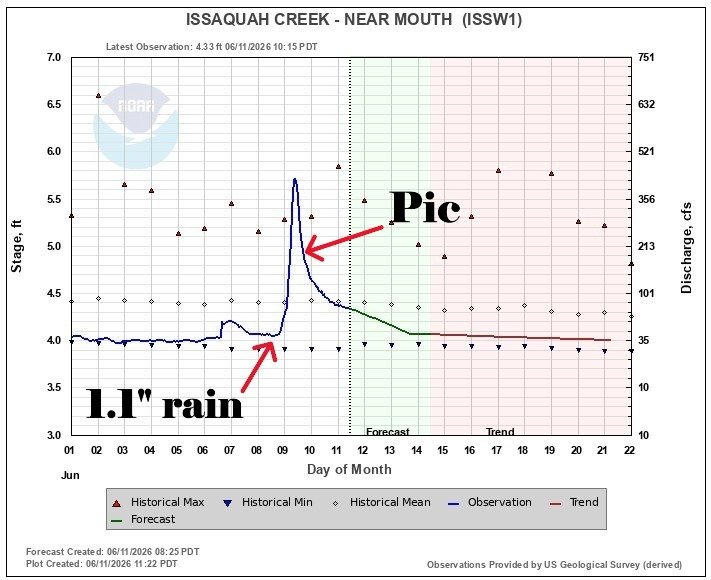
A recent example of our “flashy” watershed: just over an inch of rain increased the measured flow 10-fold a few minutes later. Courtesy of Larry Franks.
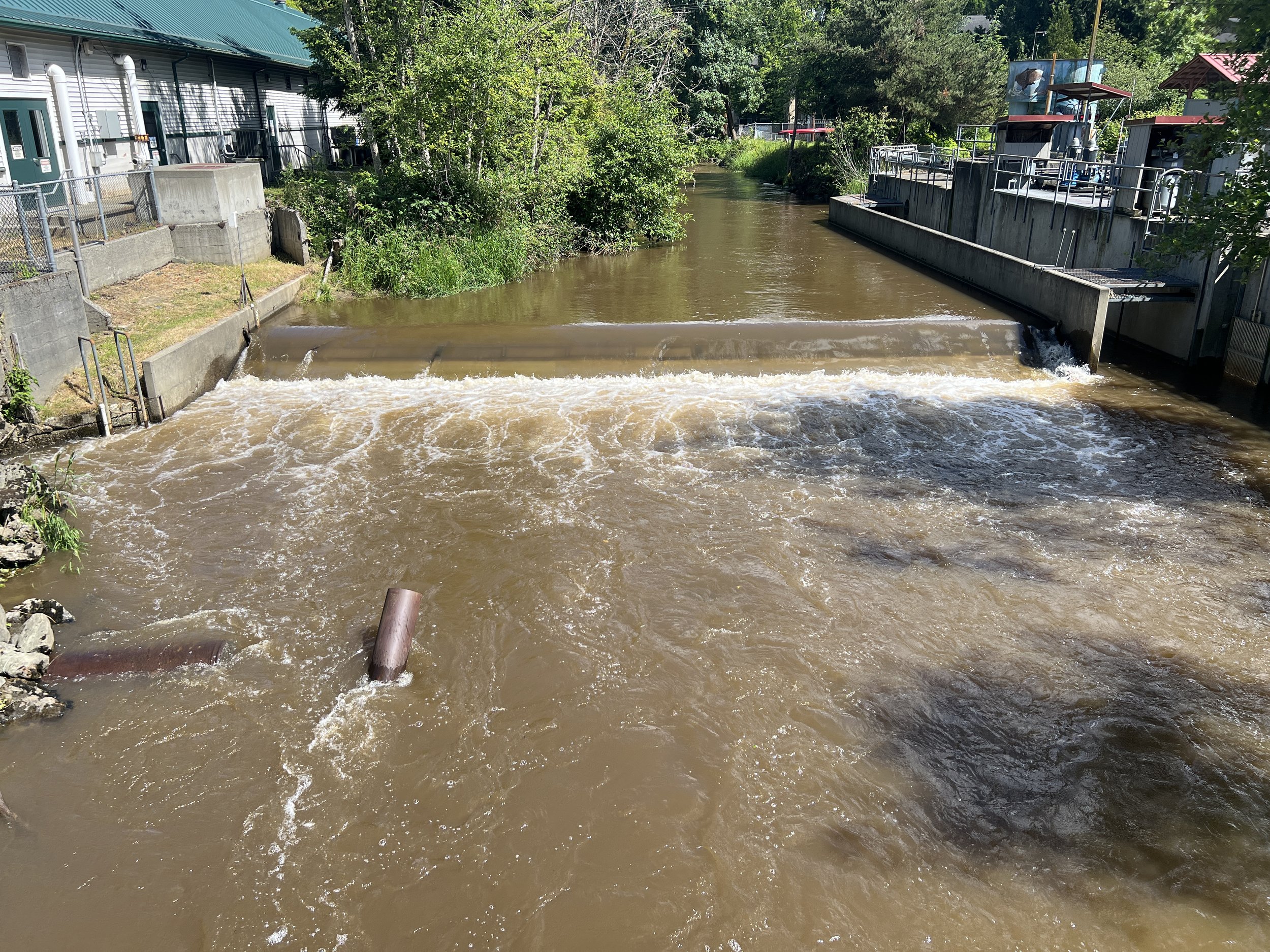
This picture shows the muddy nature of the “flashy” runoff, even several hours after the peak flow. Bear in mind that muddy water erodes gills and is just as irritating and health-impacting as very smokey air for humans. Courtesy of Larry Franks.
There are many potential mitigations. In general, we can slow the flow of water to the mainstem through rain gardens, collecting roof runoff in cisterns (and using the water later), and similar measures. The "silt fences" (the short orange plastic fences ubiquitous at construction sites) can help filter the mud, but many are poorly installed—it does not take much of a gap to transport all that mud to the mainstem. Enforcing setbacks and required riparian zones can help as well. I like a natural approach of providing sufficient space for high water to spread out and slow down, coupled with large wood in the stream to not only slow the flow but also provide refugia for small salmonids while they grow in the stream and eventually transit to saltwater. Attention to these details can help us hang onto the Goldilocks Zone as long as possible in the Issaquah Alps.