
City of Issaquah Tradition Plateau Forest Management Plan
By Dan Hintz, Urban Forest Supervisor, City of Issaquah
One of the great features of the Issaquah Alps is that you can walk along seemingly endless trails through public land. If you are just out for a hike and some forest bathing, it doesn’t really matter which government agency manages those lands; the key is they are public and open to all.
That being said, the Issaquah Alps consist of a complex patchwork of land managers. People hiking on Tradition Plateau may be surprised to know that most of those trails are part of the City of Issaquah. The City and Washington Department of Natural Resources (DNR) co-manage the West Tiger Mountain Natural Resource Conservation Area (NRCA), with the city owning approximately 430 acres in the NRCA. Much of this land was originally acquired for the Old Issaquah Waterworks.
Today these Issaquah managed open spaces on Tradition Plateau are covered by a 92% tree canopy. That seems impressive, but if you go “under the hood”, you start to realize that forest conditions can vary significantly. This is where the idea of “forest health” comes in. Forest health is the ability of a forest to maintain its biodiversity, ecological processes, and resilience. Threats to forest health include climate change, invasive species, pests and pathogens, and certainly humans.
Over the past century plus, the foothills of the Issaquah Alps have been clear cut and stripped of its trees multiple times. This logging history still has enormous impacts on the present day forest health of Tradition Plateau. To better examine current conditions and explore management options to improve forest health, the City of Issaquah worked with ecological forestry experts at Northwest Natural Resource Group to develop a 30-year forest management plan for the city managed lands on Tradition Plateau.
The Tradition Plateau Forest Management Plan was completed this past winter. The Plan breaks down the landscape into nine unique Forest Management Units (FMU’s) based on their current forest conditions. FMU’s range from mature Douglas fir forest types with ~70 trees per acre (FMU 7 - within the range of what you’d expect to see in an old growth forest) to densely overstocked areas of young red alder and western hemlock (FMU 5 – 355 trees per acre) and Douglas fir “dog-hair” forests (FMU 4) with 210 trees per acre.
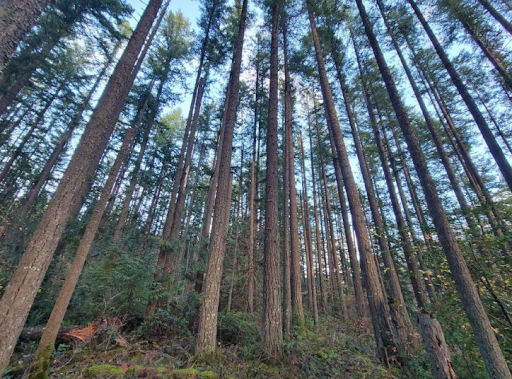
FMU 4 is dominated by densely stocked, uniform aged Douglas fir
Forest management recommendations range from actions already ongoing, like invasive species control and high-biodiversity (conifer and deciduous trees) focused planting efforts, to more “cutting edge” forestry approaches like ecological thinning and assisted migration.
It may feel counterintuitive to talk about the negative impacts of historical logging and then suggest removing trees, but the fact is, several of the forest management units on Tradition Plateau are overstocked, leading to low species and structural diversity in the forest. Ecological thinning can essentially speed up the process of forest succession. It can also have benefits for water management, fire resilience, and wildlife habitat (and understory plants for animals to forage on).
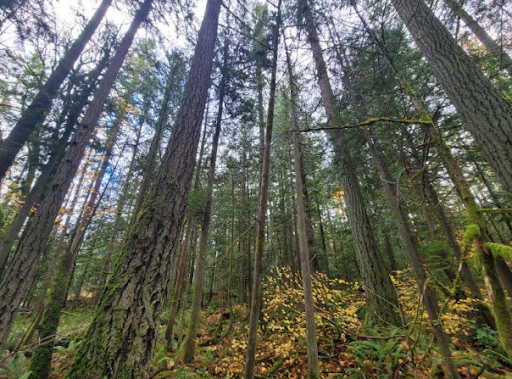
FMU 7 contains some of the most mature forest found on Tradition Plateau, with an overstory of large Douglas fir and a well-developed midstory of western redcedar
No thinning projects or assisted migration efforts are currently planned, but the Tradition Plateau Forest Management Plan identifies areas and approaches that may be appropriate for this type of work in the next few years. Assuming these types of projects gain traction, there will be a community engagement process and consultation with neighboring land managers (like DNR and King County) and Tribes.
The Tradition Plateau Management Plan is an information-dense document, so if you have limited time, reviewing the FMU Section (pages 46-67) will give you the most local information for the forests that you likely hike through. If you have questions on this effort or other urban forestry initiatives at the City of Issaquah, please feel free to reach out to me at danielh@issaquahwa.gov.