
Balancing Growth and Conservation: Then vs. Now
By Kelly Jiang, IATC Board President and Issaquah City Councilmember
Since the earliest days of the Issaquah Alps Trails Club, IATC has understood that conservation is most successful when paired with denser housing. As the population of the Seattle area has more than doubled since IATC was founded (from 1.75 million in 1979 to 3.58 million today), building enough homes for everyone to live in, while conserving our green spaces, has been a huge focus for the entire state of Washington.
Some early examples of IATC’s emphasis on pairing denser development with conservation include the Issaquah Highlands and Talus. In the Issaquah Highlands, the land was originally zoned for one home for every 5 acres. Instead, IATC and the City of Issaquah helped broker a deal with the developer, where denser housing and retail were concentrated on only ~25% of the land, with the remaining ~75% of land set aside as open space, including the 1,200-acre Grand Ridge Park. In Talus, similarly, denser housing was concentrated on about 25% of the land, with the remaining 75% of land set aside as the city-owned “Talus Open Space,” which is adjacent to both Cougar Mountain Regional Park and Squak Mountain State Park.
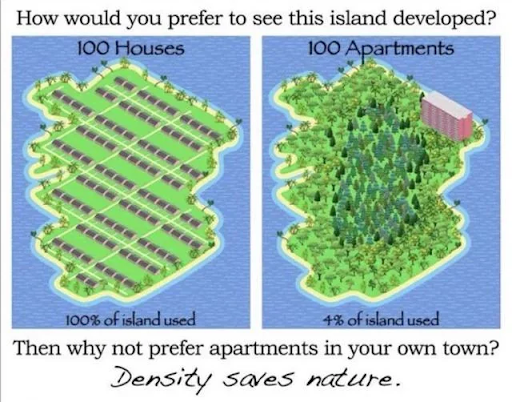
Denser housing can allow for open space conservation on this island, and in Issaquah as well!
Most of the undeveloped land in Issaquah is now permanently protected as open space. As a result, future housing growth will need to come from “infill” redevelopment - in other words, replacing older properties with newer ones.
In 2012, the City of Issaquah adopted the Central Issaquah Plan, which aims to guide the evolution of “Central Issaquah,” which currently consists primarily of strip malls and parking lots, into an urban center. Central Issaquah has zoned capacity for 7,500 homes - for comparison, the Issaquah Highlands has zoned capacity for ~5,000 homes. Building mixed-use neighborhoods in Central Issaquah can help us accommodate new neighbors without encroaching on our beloved green spaces.
However, we also want to ensure that our new neighbors who live in Central Issaquah are also able to easily access the green spaces that are so unique to Issaquah. The CIty of Issaquah’s new Park System Plan, adopted in November 2024, envisions the future of Issaquah’s “Creeks to Peaks” park system, where “every park and trail is interconnected to create a cohesive network.”
Currently, 68% of homes in Issaquah are within a half-mile walk (~10 mins) to a city park or open space, and 56% of homes are within a quarter-mile walk (~5 mins) to a trail, including paved multimodal trails (e.g. Rainier Trail). We hope that this proportion goes up over time so that more residents of Issaquah are able to access our parks and trails. This will likely require building out our within-city trail network to make it safer to walk and bike around town to access parks and all of our other daily needs. This may also require building more parks in Central Issaquah.
In particular, Issaquah’s decades-long strategy of buying up land located in the 100-year floodplain has provided many opportunities for parks. Salmon Run Nature Park, Berntsen Park, and Confluence Park are all examples of land that was purchased for the dual purposes of floodplain management and open space. As Central Issaquah develops, additional parks along Issaquah Creek can provide vital green spaces for our new neighbors while also helping manage the impacts of major flooding events, like what we witnessed in December 2025.
As Issaquah plans for its future, including the arrival of light rail, IATC will continue to advocate for striking the right balance between conservation and smart growth. If you’re interested in getting involved in advocacy, please don’t hesitate to reach out to us at advocacy@issaquahalps.org!