
2026 IATC Public Forum Recap
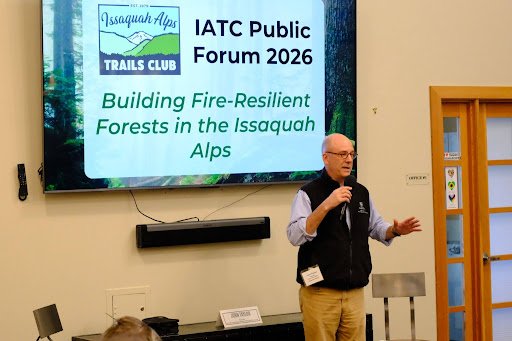
Director of King County Department of Natural Resources and Parks, John Taylor, giving his keynote address. Photo courtesy of Tom Anderson.
This April, IATC held its sixth annual public forum, themed Building Fire-Resilient Forests in the Issaquah Alps. Given this year’s low snowpack and the increasing pressures our forests are experiencing due to climate change, we wanted this year’s forum to focus on how we steward our local forests in regard to wildfire prevention.
We were honored to welcome the Director of King County Department of Natural Resources and Parks (DNRP), John Taylor, as our keynote speaker. Director Taylor brings a wide breadth of experience to his office, including a deep background with urban salmon restoration work and circular economy initiatives. Director Taylor has over 20 years of leadership experience in the private and public sectors and now manages over 2,000 employees as well as the county’s largest capital portfolio.
In his keynote address, Director Taylor framed our theme for our audience, explaining the role of the DNRP in land stewardship and restoration. He highlighted the importance of a holistic approach to land management and detailed DNRP’s approach to wildfire risk management and forest stewardship on the whole as a four-prong approach: preparing, coordinating, stewarding, and responding.
Director Taylor’s closing remarks were ones of optimism: “We know exactly what we need to do to prevent [wildfires] from happening and what investments we need to make to respond to them if they do.” For Director Taylor, he noted that the key to preventing wildfires will be educating the public and acting on the science and technology that we already have access to.
A panel of community experts followed Director Taylor’s keynote address. Vaughn Cork, the Fire Regulation Program Manager for WA Department of Natural Resources, Mike Lasecki, Stewardship Forester and Wildfire Mitigation Specialist for King County DNRP, and Cat Robinson, Emergency Coordinator, Eastside Fire and Rescue, weighed in on what it takes to build a fire-resilient forest and how our land managers and community members can continue to be good stewards of our public lands.
When asked what a fire-resilient forest looks like, our panel responded unanimously: it depends. “What determines what a fire-resilient forest looks like depends on that local forest ecosystem and the climate that that ecosystem evolved with,” offered Mike Lasecki. Lasecki cited that an excellent example of a fire-resilient forest in our area is the Cedar River Watershed, given its species makeup, age classes, and the lesser degree of invasive species in the area. As our panelists noted throughout the evening, if a forest with a large percentage of invasive species experiences a wildfire, the first species to grow back afterwards, and often the ones with the most tenacity are invasive species. When we think about wildfire mitigation, general forest health and restoration work are key factors.
Lasecki pointed out that when thinking about what makes a fire-resilient forest, we also can’t forget the human components. A fire-resilient forest coexists with well-managed buildings and infrastructure, infrastructure that’s designed not to ignite and perpetuate wildfire risk. “We shouldn’t just think about it as there is a forest and there is us in our communities. We are intermixed; we are intermingled; we are connected. We’ve got to be thinking about both when we talk about resilience to wildfire.”
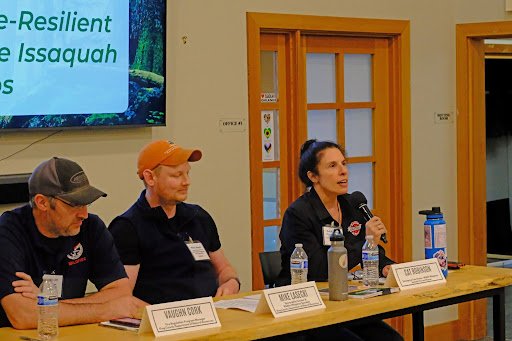
Our expert panel from L to R: Vaughn Cork of WA Department of Natural Resources, Mike Lasecki of King County Department of Natural Resources and Parks, and Cat Robinson of Eastside Fire and Rescue. Photo courtesy of Tom Anderson.
A growing concern of the public as we look towards this upcoming fire season is this year’s severely diminished snowpack. Just weeks ago, a statewide drought was declared. As Vaughn Cork noted, “As snowfall and snowpacks diminish, we tend to see our snowpacks and fire seasons go on a varying scale. They look kind of like a groove on a record.”
Cork explained how duration and timing of rainfall are also critical factors in determining wildfire risk. If snowfall and rain occur in sufficient amounts at the right times of the year, say in late spring or early summer, wildfires may be kept at bay thanks to water retention in seasonal creeks and riparian areas. “[Rainfall] keeps those seasonal creeks full, which, when we have fires on the landscape, if those seasonal creeks still have a little bit of water in them, those riparian areas help to naturally contain fires and stop their spread and provide a lending hand to the fire crews on the ground.”
Our final question to our panelists for the evening was a simple one: If someone leaves tonight and does one thing, what should it be? Our panelists were quick to point out the importance of home assessments, which residents can do through Wildfire Safe Eastside’s Home Assessment Program—the program Cat Robinson spearheads.
In her response to this final question, Robinson turned to the audience and asked them simply, “What are the top three causes of wildfire?” Our audience shouted out the usual suspects: lightning, campfires, equipment… and finally, people. Robinson nodded earnestly, garnering a laugh from the crowd while confirming that three main causes of wildfire were indeed people: “Yes, men, women, and children—people.”
Robinson explained that a large part of her job at Eastside Fire and Rescue is providing residents with the resources necessary to help themselves. “It starts with education; it starts with awareness. Knowing how to plan, knowing what to plan, knowing that we have to become more fire-adapted communities.”
Thank you to all who volunteered and attended our sixth annual public forum, and a special thank you to our keynote speaker and panelists.
If you were unable to attend the Public Forum, you can watch the recording on the IATC YouTube Channel.
Learn more about IATC’s long history of advocacy and our continued commitment to the conservation, education, and advocacy for the land, wildlife, and trails of the Issaquah Alps for present and future generations.